
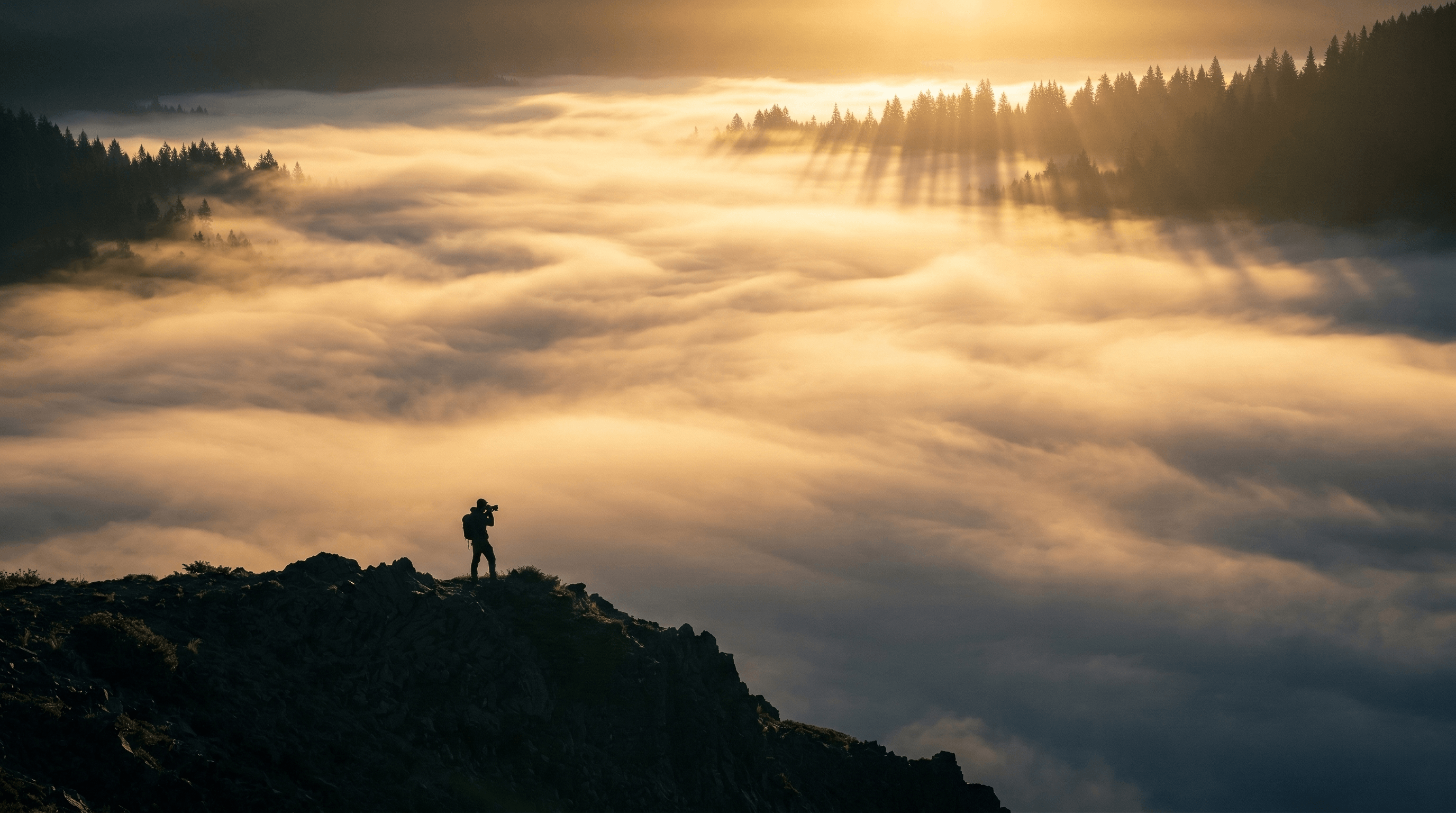
The 3:00 AM Problem
As a landscape photographer, I am always chasing the sublime—that fleeting feeling of being small in the face of nature’s raw, mysterious power.
But as a designer and a dad, my time is a non-renewable resource. I can’t afford to wake up at 3:00 AM and drive two hours into the mountains only to find a flat, grey overcast sky.
For years, I relied on standard weather apps to plan my mornings. And for years, I missed incredible conditions. Why? Because most weather apps—and most photographers—rely on a flawed metric: Visibility.
The "Lagging Indicator" Trap
Standard weather apps are built for commuters and pilots. They track "Hazardous Fog." Visibility is what we call a lagging indicator—it tells you fog is already there. If you wait for the "Fog Icon" or a low visibility report on a standard app, you’ve likely already missed the "blue hour" setup and the most stable atmosphere of the morning.
To drastically improve your hit rate, you have to stop looking at the symptoms and start looking at the causes. You need to become a master of pattern recognition. You need to track the leading indicators.
The Old Way Generic Weather Apps | The Fog-Index Way Pattern Recognition |
|---|---|
Signal Stack The 'Fog Icon' & Visibility | Signal Stack DPD + Wind Memory + Terrain |
Logic Lagging (Symptom-based) | Logic Leading (Cause-based) |
Result 3:00 AM Gambles | Result High-Probability Hits |

The First Principles: The Essential Recipe
The "magic" of fog happens when specific atmospheric processes act on core ingredients. Whether you are hunting inversions in deep alpine valleys, chasing the marine layer along the Pacific coast, or waiting for post-storm mist in the plains, the recipe always requires three things:
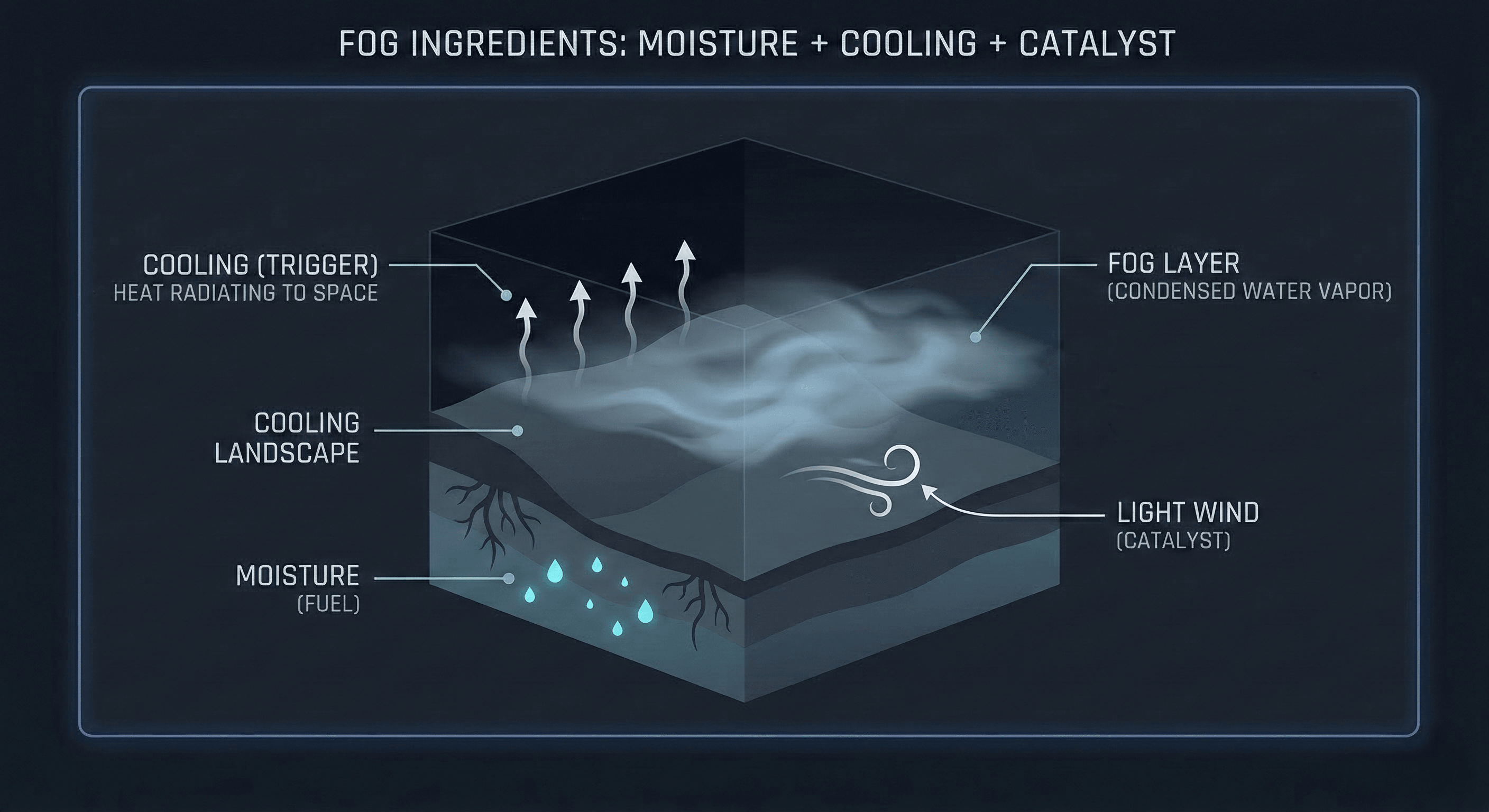
1. Moisture (The Fuel)
Fog is simply a cloud resting on the ground, and it requires a high concentration of invisible water vapor to form. This usually comes from wet soils and vegetation continuously evaporating moisture into the boundary layer, often after a recent rain. But it can also be imported: transported hundreds of miles by marine winds blowing off the ocean, or added dynamically when warm rain evaporates into a cooler airmass.
2. Cooling (The Trigger)
Warm air can hold more water vapor than cold air. If you take a moist airmass and cool it down, its capacity to hold that moisture shrinks. When the temperature drops to the exact point of saturation (the dew point), the invisible vapor is forced to condense into billions of tiny liquid droplets. This cooling trigger happens in three primary ways:
- Radiational Cooling: On clear nights, the ground rapidly loses heat to space, chilling the moist air resting just above it (Radiation Fog).
- Contact Cooling: Warm, moist air is physically blown over a much colder surface, like a frigid ocean current or a snowpack (Advection Fog).
- Lift Cooling: Wind forces moist air up a mountain slope, causing the air to expand and cool as it rises (Upslope Fog).
3. Wind & Mixing (The Catalyst)
You might think fog requires absolute, dead calm. It doesn't. Wind is the ultimate fog regulator, and you are always looking for a specific "Goldilocks" zone:
- If the air is completely still, the moisture condenses directly onto the ground as heavy dew or frost, robbing the air of the vapor needed to form fog.
- To build a deep, photogenic "valley fill", you need a very slight breeze (1–5 mph) to gently stir the cooling air upward.
- For coastal or mountain fog, wind is the engine driving the system, transporting moist air or pushing it up terrain at moderate speeds (5–15 mph).
- If the wind blows too hard, it violently mixes dry air down from the atmosphere above, destroying the fog layer completely.
The Signals That Matter
Good fog calls come from Signal Stacking: several meteorological indicators lining up in the same direction. Here are the three signals you must track.
The Spread
The Mixer
The Lid
1. Dew Point Depression (The Spread)
If you only track one thing, track the Dew Point Depression (DPD). This is the mathematical difference between the actual air temperature and the dew point. It is the ultimate measure of saturation.
- The Danger Zone: DPD > 4°F. Stay in bed. The air is too "thirsty" to hold mist.
- The Sweet Spot: DPD ≤ 1.5°F. This is where the atmosphere is essentially saturated.
- The Coastal Nuance: While inland valleys rely on the air cooling down to meet the dew point, coastal photographers should watch Sea Surface Temperature (SST). When warm, moist air moves over a colder ocean current, the "Spread" is forced shut from the bottom up.
2. The "Goldilocks" Wind Speed
Wind is the ultimate radiation fog killer, but dead calm is a trap. You are looking for a highly specific zone based on the fog type.
Radiation / Valley Fog
Needs 1–5 mph. Just enough to stir the cooling air upward. Anything more than 7 mph usually "rips" the fog apart and prevents it from settling into the valley floor.
Advection / Marine Fog
Needs 5–12 mph. Since this fog is "transported" from the ocean to the land, it needs a stronger breeze to push the moisture inland and into the trees.
3. Cloud Timing (The Lid)
For fog to persist, it needs a "Lid"—something to keep the moisture trapped near the ground.
- The Radiation Lid: For valley fog to form, the ground must lose its heat rapidly to space. If the sky is covered in thick clouds overnight, they act like a blanket. You are looking for a transition: a wet day followed by skies clearing out (under 30% cloud cover) in the 4 to 6 hours before sunrise.
- The Marine Lid (Inversion): In coastal environments, the "lid" isn't the sky clearing; it's a Temperature Inversion. This happens when a layer of warm air sits on top of the cool, foggy marine air, squashing the fog into a dense, low-lying deck.
Bringing It Together: The Terrain Context
You can have the perfect spread, the perfect wind, and clear skies, but if you are standing on the wrong topography, you'll miss the shot.
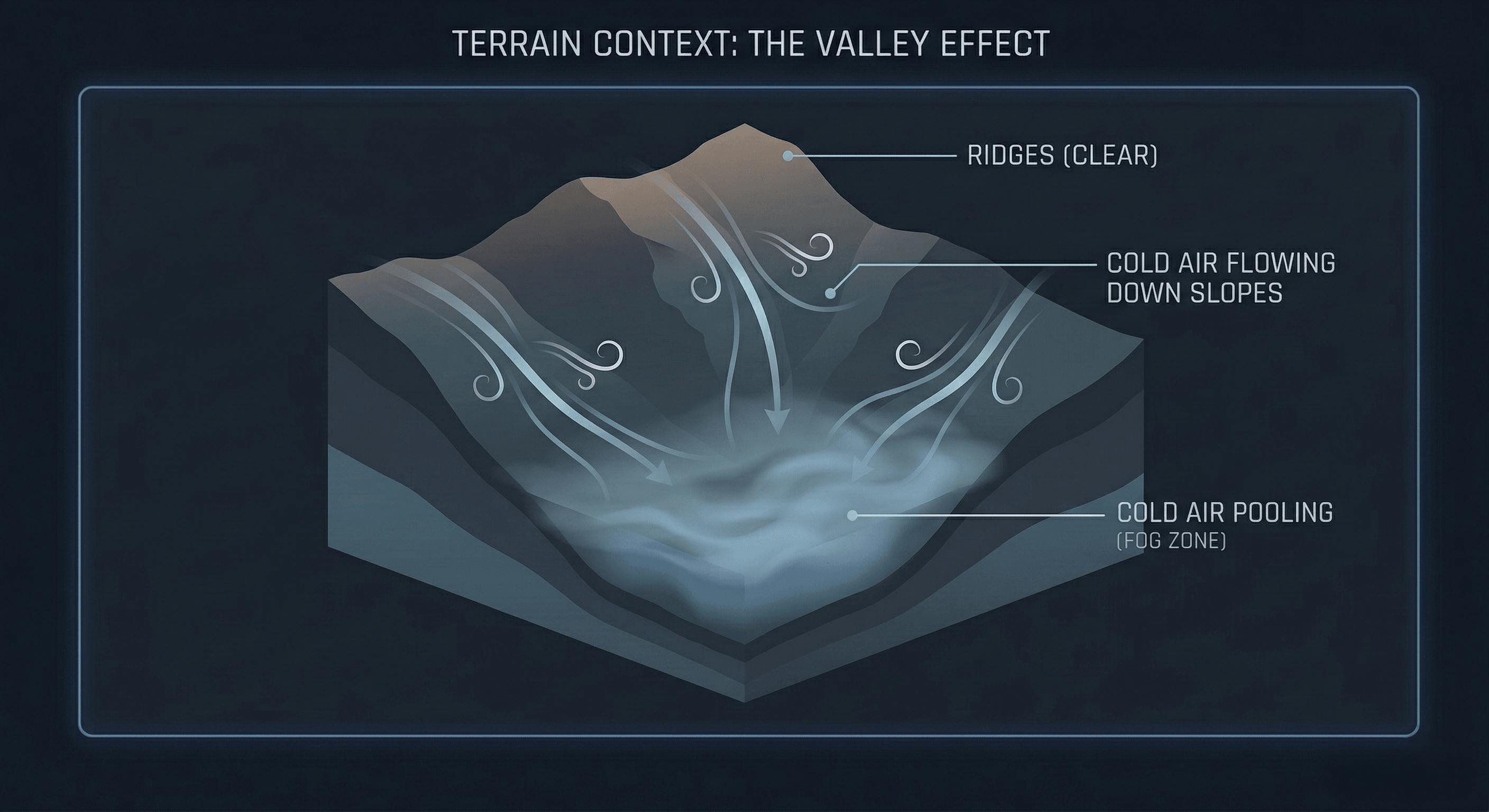
Think of cold, heavy air like water. During clear nights, it drains off the ridges and pours down the slopes, collecting in the lowest possible places.
The Fog-Index Workflow
Signal stacking manually across a dozen weather apps every night is exhausting. It takes time away from your family and your art. That is exactly why I built Fog-Index.
The algorithm doesn't just look at visibility. It crunches the Dew Point Depression, evaluates the wind memory of the boundary layer, checks the cloud-clearing prep windows, and cross-references your specific terrain to generate a single 0-100 score.
It is a system designed to do the math for you, so you can focus on being the witness to the landscape, not the calculator of the atmosphere.